COMPUTER VISION · SPORTS DATA ENGINEERING · IN PROGRESS

NBA Court Vision Tracker

Broadcast video to player and ball positions on the court, in meters

Optical player tracking exists only in arenas that install it, and its data is rarely public. Broadcast video exists for nearly every game. This project asks how much trustworthy spatial data can be recovered from the broadcast alone. The pipeline now runs end to end on real NBA footage. This page is about the decision that has mattered most so far: refusing to trust a camera estimate just because it scored well.

Individual project · Python · OpenCV · ONNX Runtime · October 2026 · CPU only, no GPU

INPUTBroadcast video720p · clips of 11–113 s
CAMERAPTZ calibrationLandmark clicks + court lines
OUTPUTCourt meters + σObserved / interpolated / unknown
STATUSGround truth in progressTracking accuracy not yet measured
01 — THE CHALLENGE

Every game is filmed. Few are tracked.

A box around a player is not a court position. The broadcast camera pans and zooms constantly, so turning pixels into meters requires knowing where the camera is pointing in every frame. That camera estimate is the foundation everything else stands on: if it is wrong, every player in the frame is wrong with it.

Real broadcast excerpt, 15 s, camera panning about 28°. Left: tracked players and court lines projected through the estimated camera. Right: the same players on a top-down court in meters; rings show 2σ uncertainty. Portland at Golden State, NBC Sports Bay Area; shown for research demonstration only.

STEP 01[ ]

Detect

RF-DETR finds players; a basketball-specific heatmap model (WASB) finds the ball.

STEP 02θ, f

Calibrate

From a few landmark clicks on one frame, the camera's pan, tilt and zoom are followed through the video using camera motion and the painted court lines.

STEP 03ID

Track

A multi-object tracker with camera-motion compensation links detections over time.

STEP 04m ± σ

Project

Each player's ground point becomes court meters with an uncertainty.

02 — THE FAILURE

The dangerous error is a confident one.

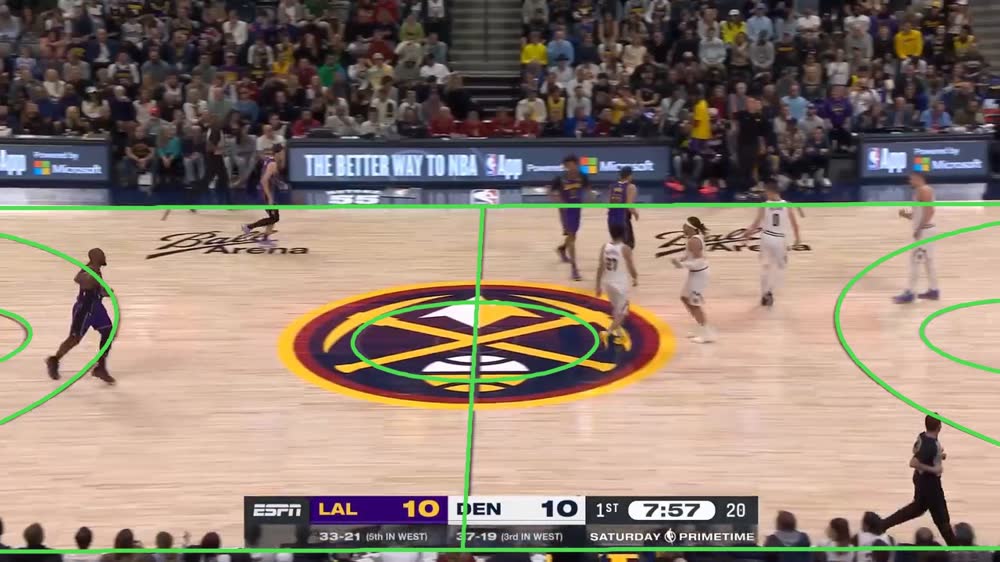
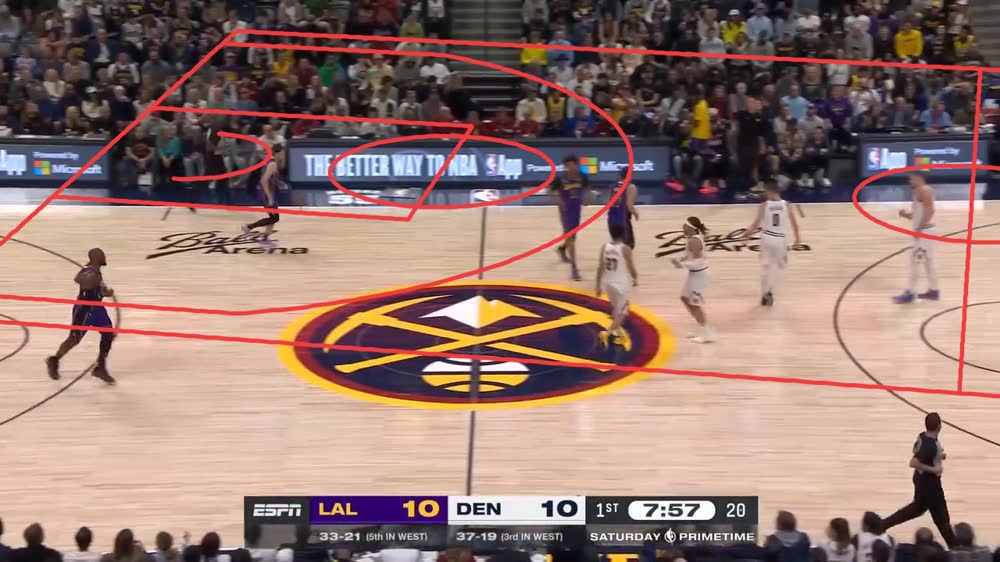
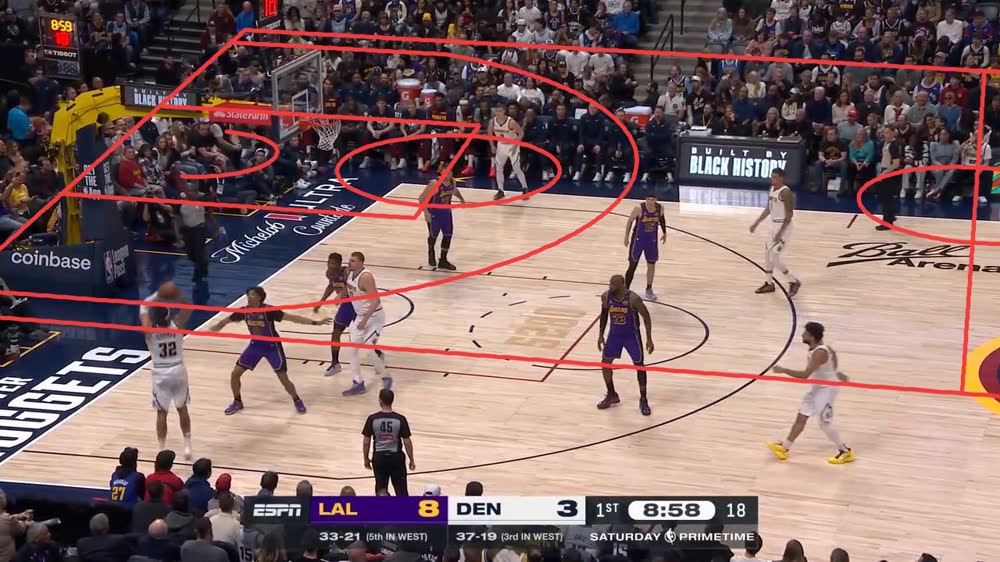
My first acceptance rule asked one question: do the projected court lines land on lines in the image? When I tested the camera solver on 17 frames it had never been tuned on, it produced 272 wrong solutions, and that rule accepted 85% of them. An automatic re-initialization after camera cuts failed on all three frames it was tried on; the line-scored version drew the court across the stands and still earned a high alignment score.

TRY IT · REAL FRAME 2400

Is this camera estimate correct?

REAL FAILURE, 15 OCT 2026
A broadcast frame with a court outline drawn in red across the stands and the basket support, not on the floor

Red lines: the court as projected by the estimated camera.

Reveal what the old rule said ↓

The old rule accepted it. 83% of the template's line points matched an edge, above the 55% threshold.

A crowd is full of edges: railings, signage, rows of seats. A court drawn over the stands can therefore look like an excellent line fit. The rule was checking the solver with the same kind of evidence the solver had just optimized, so it could not catch the solver's mistakes.

Court lines in green aligned with the real floor markings
ACCEPTEDCorrect pose · frame 6100Line inliers 0.89 · floor IoU 0.76
Court lines in red drawn over the stands above the floor
REJECTEDCourt on the stands · frame 6100Line inliers 0.63 · floor IoU 0.30
Court lines in red tilted and floating over the logo, not matching the floor
REJECTEDDiverged fit · frame 6100Line inliers 0.37 · floor IoU 0.27

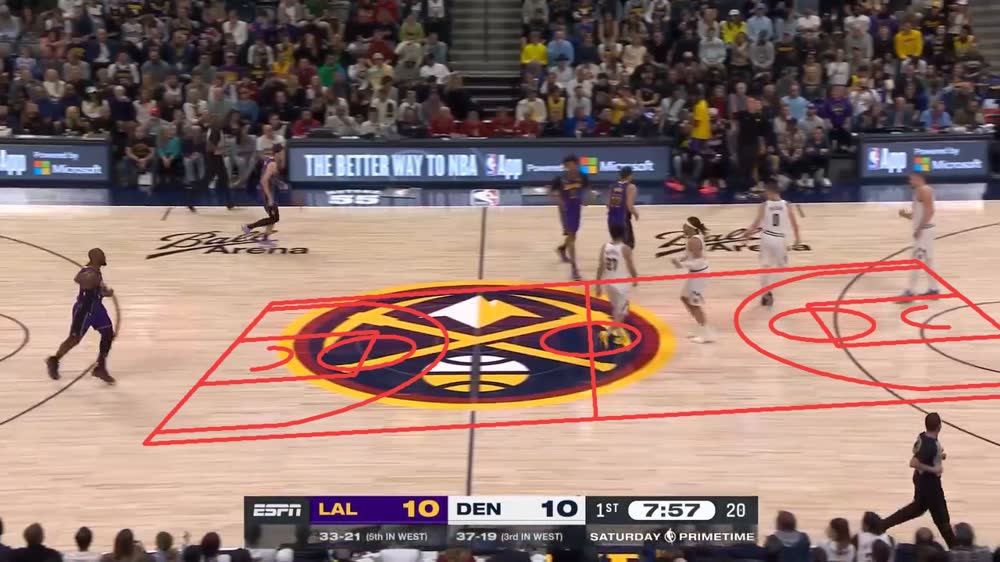
The same frame with three camera estimates. These failures are stored as regression tests (tests/unit/test_calibration_gates.py).

03 — THE GATE

Check the answer with evidence the solver did not use.

The new gate grades every frame on three signals. Line alignment must be stronger: at least 70% of the court's line points must land on an image edge. The projected court must agree with where the wooden floor actually is, which is measured from floor color and is independent of the line fit. And the camera must not jump implausibly from the previous frame. Frames that fail keep their image-space tracking but receive no court coordinates, because a missing position is safer than a wrong one.

THE SIGNALS FOR THE FOUR POSES SHOWN ABOVE
PoseLine inliersFloor IoUCourt coverageOld rule (≥ 0.55)New gate
Correct · f61000.8870.7600.769acceptsgood
Court on stands · f61000.6330.3000.445acceptsfailed
Court on stands · f24000.8300.2510.357acceptsfailed
Diverged fit · f61000.3740.2670.738rejectsfailed

Computed by tools/make_gate_figure.py from the regression fixtures.

BEFORE AND AFTER

Wrong camera solutions accepted

272 naturally occurring wrong solutions on unseen frames · MEASURED · PARTLY POST-HOC

Old rule
85%
New gate
3.3%

Deliberately perturbed wrong poses accepted

980 poses on clips 1–5 · MEASURED

Old rule
27.6%
New gate
0%

The cost: correct poses wrongly rejected

98 verified real poses · MEASURED

Old rule
0%
New gate
1.0%

Three caveats. The 980 perturbed poses all come from real clips; adding 80 from a synthetic arena, the gate accepts 2 of 1,060 (0.2%), both synthetic. One loophole, a tiny projected court sitting entirely inside the floor, was found and closed after I saw the unseen-frame results, which moved acceptance from 14 to 9 of 272, so the 3.3% is partly post-hoc. And stricter is not free: the gate is over-cautious on fast, blurred pans (about 0.6% of frames on the long video). Raising the line threshold to about 0.76 would remove most of the remaining 9 wrong solutions but would also reject about 5% of the correct frames on one wide-angle clip, so I kept the current balance.

04 — OTHER FIXES AND DEAD ENDS

The same habit, applied beyond the camera.

BALL IN FLIGHT

A rule deleted the ball during shots

2.39 s1.30 slongest gap without a ball (long video, main camera)
35.7%29.2%frames missing a ball (same segment)

A clutter filter discarded ball candidates that projected far from the court. But a ball high in the air always projects far away, so the filter was deleting shots in flight. Removing it added ball frames on four clips and removed none, and all 48 restored frames I sampled showed the real ball.

MEASURED · VISUAL CHECK 48/48
SPECTATORS AS PLAYERS

Front-row fans placed on the court

22%3%frames with more than 10 "players"
8744coordinate jumps

Front-row fans whose feet are hidden behind the courtside crowd were being projected onto the court as players. The fix compares each box's height with the expected height of a standing person at that court position. These are proxy numbers from the same 17-second interval used to set the thresholds, not accuracy.

PROXY · DIAGNOSTIC INTERVAL
TRIED AND REJECTED

Ideas that did not hold up

3 / 3automatic re-initializations failed after a cut
0safe offline track-stitching links found

Recovering the camera after a cut still needs one manual keyframe. A height-consistency rule helped on the tuning interval but increased track fragmentation on unseen frames, and a longer lost-track window merged players from different teams. Both were left off. Offline track stitching found no link it could make safely.

MEASURED · NEGATIVE RESULTS
05 — WHAT IS AND IS NOT KNOWN

What is solid, and what is not yet.

ESTABLISHED
  • Runs end to end on real broadcasts, including a 113 s multi-camera video with cuts and photographer flashes
  • Calibration gate rates above, against verified reference poses
  • Every output row states whether a position was observed, interpolated or unknown
  • 121 automated tests, including regressions built from real failures
NOT YET MEASURED OR SOLVED
  • Tracking accuracy (HOTA, IDF1): reviewed ground-truth annotation is in progress
  • Position error in meters
  • Identity over time: about 48 player tracks in 97 s where about 10 would be ideal
  • Possession-boundary precision and recall for the video index
06 — NEXT

Measure it, then fix identity.

Human-reviewed annotations of three 10-second intervals are in progress, so that tracking can be scored with standard metrics (HOTA, IDF1) instead of proxies. After that, the main open problem is identity: telling teammates apart needs an appearance model (re-identification), not jersey color. A companion video index already maps video time to the game clock, which opens a path to aligning public play-by-play data with the footage.

CODE AND DOCUMENTATION

Full source and validation log

Architecture, data schema, license register, and every measured number with how to reproduce it are in the repository.